Custom glass display cases for commercial galleries, artist-run centres, and hybrid gallery-retail spaces. Fabricated in Ontario to the specification your collection deserves—so visitors see the art, and nothing else.
A gallery is one of the few environments where the display infrastructure is expected to disappear. The case should not compete with the work. It should not announce itself, date the room, or remind the viewer that they are standing in front of a container. It should hold the work securely, present it at its best, and then get out of the way.
Achieving this level of invisibility requires a precision that most off-the-shelf cases cannot deliver. The proportions need to suit the work being shown. The glass needs to be so clear it is not a visible layer between the viewer and the object. The finish needs to integrate with the gallery’s interior rather than fighting it.
Obsidian Manufacturing builds custom glass display cases for art galleries across Canada and the United States. Every case is fabricated to order in our Fergus, Ontario workshop, with dimensions, finishes, and interior configurations designed around what is being shown.
The challenge with display cases in a gallery context is that the brief changes with every show. A case that works perfectly for a ceramics exhibition may be the wrong format entirely for a show of small works on paper. Most galleries solve this by accumulating mismatched cases over years, until the display infrastructure reads as a storage problem rather than a design decision.
Obsidian builds for galleries that want to solve this properly. Cases that are proportioned for the work rather than adapted from a general-purpose format. Finishes that coordinate across a show or the full gallery space. Hardware and glass specifications chosen for the specific works being displayed. And a fabricator who can deliver within the timeline that gallery programming actually requires.
The other thing most off-the-shelf cases cannot offer a gallery is restraint. Every design decision Obsidian makes works toward the same end: less visible case, more visible work.
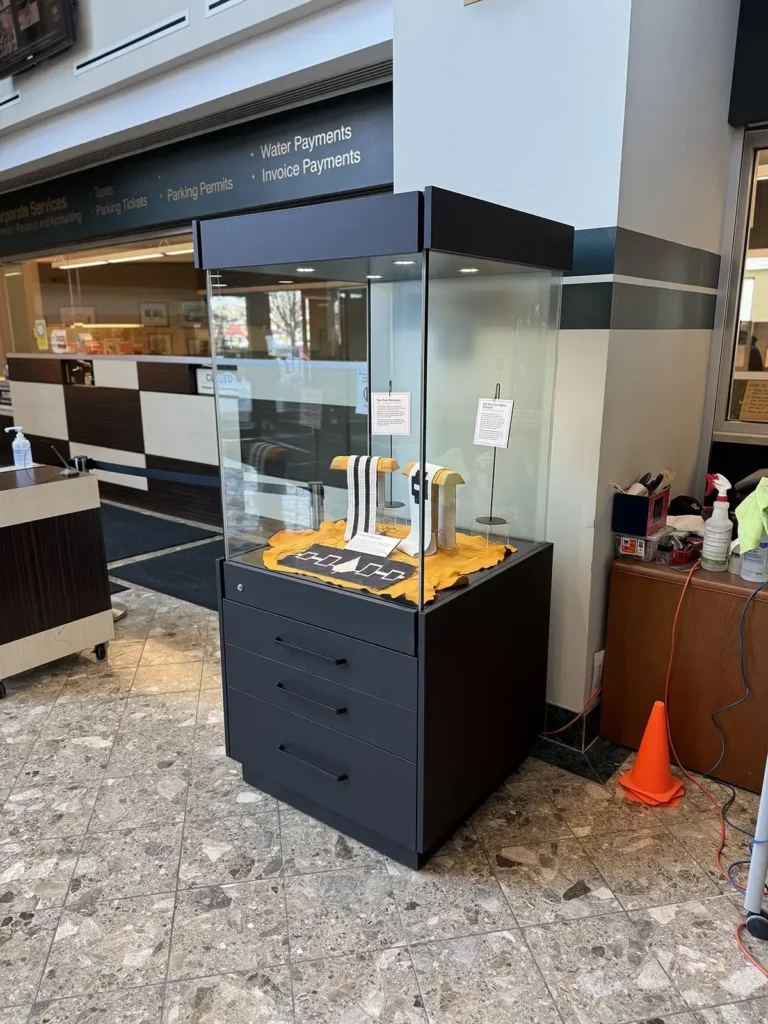
Best for: Sculpture, ceramics, glass, and three-dimensional work. Floor-standing cases available in 1/3, 1/2, and full-width configurations with top-hinged or front-access panels, adjustable interior shelving, and integrated LED lighting. The visual profile is clean and minimal so the case recedes behind the work. Available in short and tall height options.
Best for:
Works on paper, photography, prints, and archival documents.
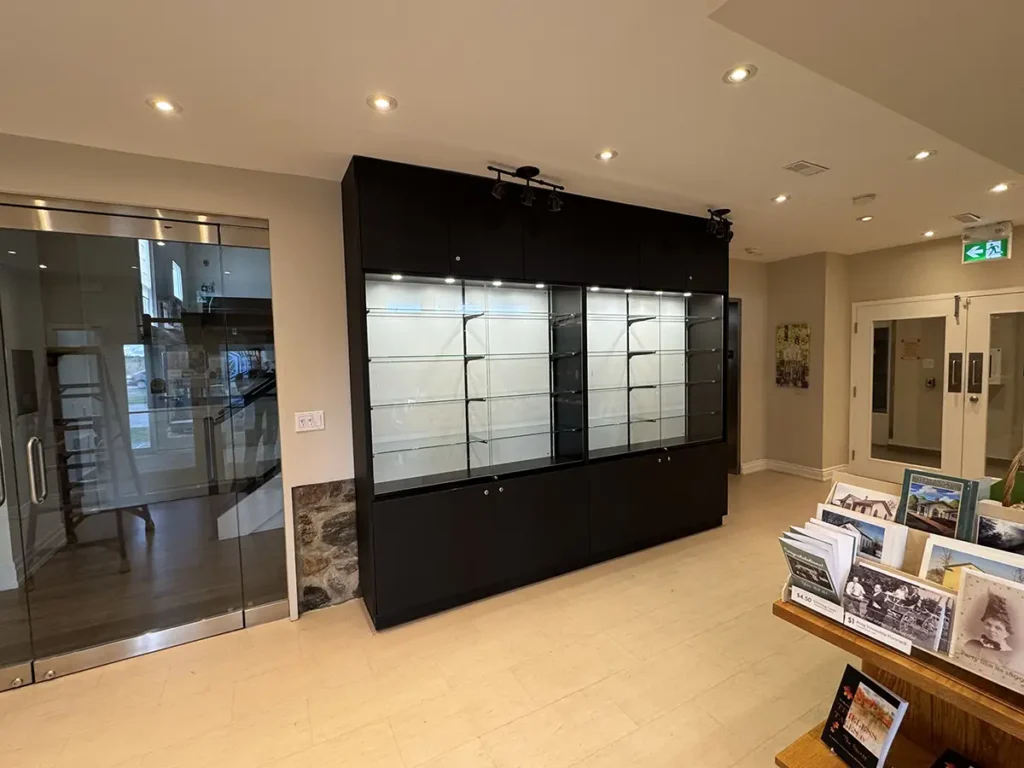
Shallow-profile cases that mount to the gallery wall. Available in 1/3, 1/2, 2/3, and full-width formats with solid or glass backs. For works where the viewer needs to see the full context of the wall behind, glass-back configurations maintain the spatial depth of the room. LED puck lighting integrated as standard.
Best for:
Creating a vertical architectural presence.
Tall, slim cases effective for works that benefit from being experienced as objects in the room—ceramics, sculptural vessels, tall framed works, and multi-piece arrangements that benefit from height. Available in short and tall formats across multiple width configurations.
Best for:
Intimate works, jewellery, artist books, and point-of-sale pieces.
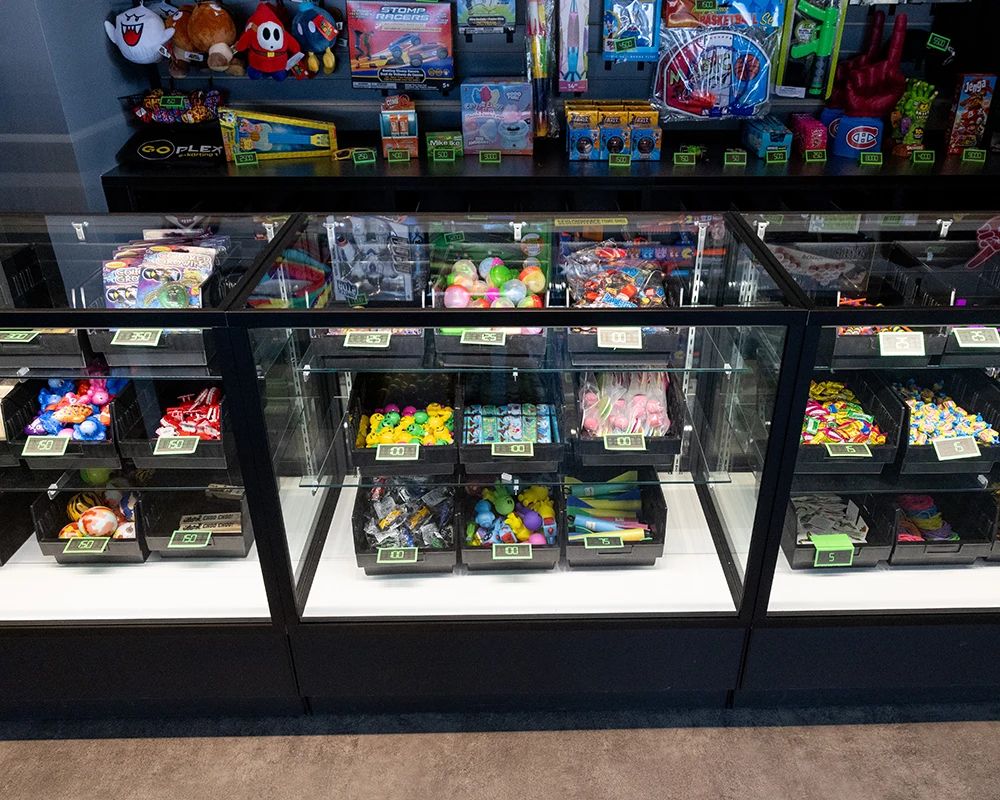
Low-profile cases for work displayed on a flat surface, inviting close viewing. Tabletop cases are compact for placement on an existing surface, reception desk, or sales counter. Both formats available with integrated lighting and the full range of finish options.
Best for:
A single significant work or tightly curated grouping.
Cases built around one featured piece, designed to give it the complete attention of a viewer entering a room. Proportions, height, and interior configuration are determined by the work being displayed, not adapted from a standard format.

Best for:
Visual consistency across the whole space.
For galleries where a unified aesthetic is part of the curatorial intention, Obsidian designs and builds coordinated case runs across multiple formats with matched finishes, proportions, and hardware. The result is a display environment that reads as a single considered decision.

Every gallery display case manages a tension that does not go away. The work needs to be visible—fully visible, without distortion, without reflections that compete with the surface. And the work also needs to be protected from handling, from environmental variation, and from accidental contact.
Most cases resolve this tension badly, prioritizing one side or the other. Obsidian builds gallery cases where both requirements are met without compromise. The glass specification, the lighting placement, the interior finish, and the frame profile are all chosen to make the work as visible as possible while maintaining the protection it requires. These are not competing goals. They are design goals that require the same level of precision.
Proprietary aluminum extrusion sourced from Toronto, and raw materials mined from Quebec. The profile is clean and minimal, designed to be as unobtrusive as possible. Durable and discrete anodized black finish is our standard. Optionally we can finish our framework in Bronze, Gold, or Silver for that unique look. Custom RAL powder coat matches are available.
Integrated 24V low-voltage LED lighting is built into every case with no exposed wiring. Showcase and table cases include a horizontal light rail. Wall cases are fitted with LED puck lights. Lighting placement and colour temperature are specified during the design phase based on the work being displayed.
Interior surfaces are finished in satin white melamine as standard. Custom interior colours, mirror back panels, and fabric-lined interiors are available on request.

Museum-grade locking hardware is standard on all gallery builds. Cases can be configured for key access on a unified lock profile, for staff-only access, or for higher-security applications.
Every gallery display case manages a tension that does not go away. The work needs to be visible—fully visible, without distortion, without reflections that compete with the surface. And the work also needs to be protected from handling, from environmental variation, and from accidental contact.
Most cases resolve this tension badly, prioritizing one side or the other. Obsidian builds gallery cases where both requirements are met without compromise. The glass specification, the lighting placement, the interior finish, and the frame profile are all chosen to make the work as visible as possible while maintaining the protection it requires. These are not competing goals. They are design goals that require the same level of precision.
Standard industry lead times run from 8 to 16 weeks. Obsidian's standard is 4 to 6 weeks. For a gallery with a programmed opening date, the difference is real.
A single pedestal case receives the same fabrication standard as a full gallery installation. There is no project too small.
Every decision works toward a case that contributes to the viewing experience without becoming part of it.
Design, fabrication, delivery, and installation are all handled by Obsidian. One call covers everything.
When you contact Obsidian, you talk to Justin or Jenny. The people who answer are the people who understand the project.
Obsidian delivers institutional-grade engineering and optics at a price point that works for commercial galleries.
Some gallery environments need infrastructure that can change with the program. For these environments, Obsidian also supplies the Logic Exhibit System: a patented modular display platform with wall units, display cases, and graphic panel components that configure and reconfigure without specialized tools.
Custom Obsidian cases and Logic components can be used within the same installation, giving galleries the ability to combine permanent cases for core collection areas with modular infrastructure for changing program spaces.
Our Process
Step 1
Step 2
Step 3
Step 4
Step 5
Testimonials
Contact Us